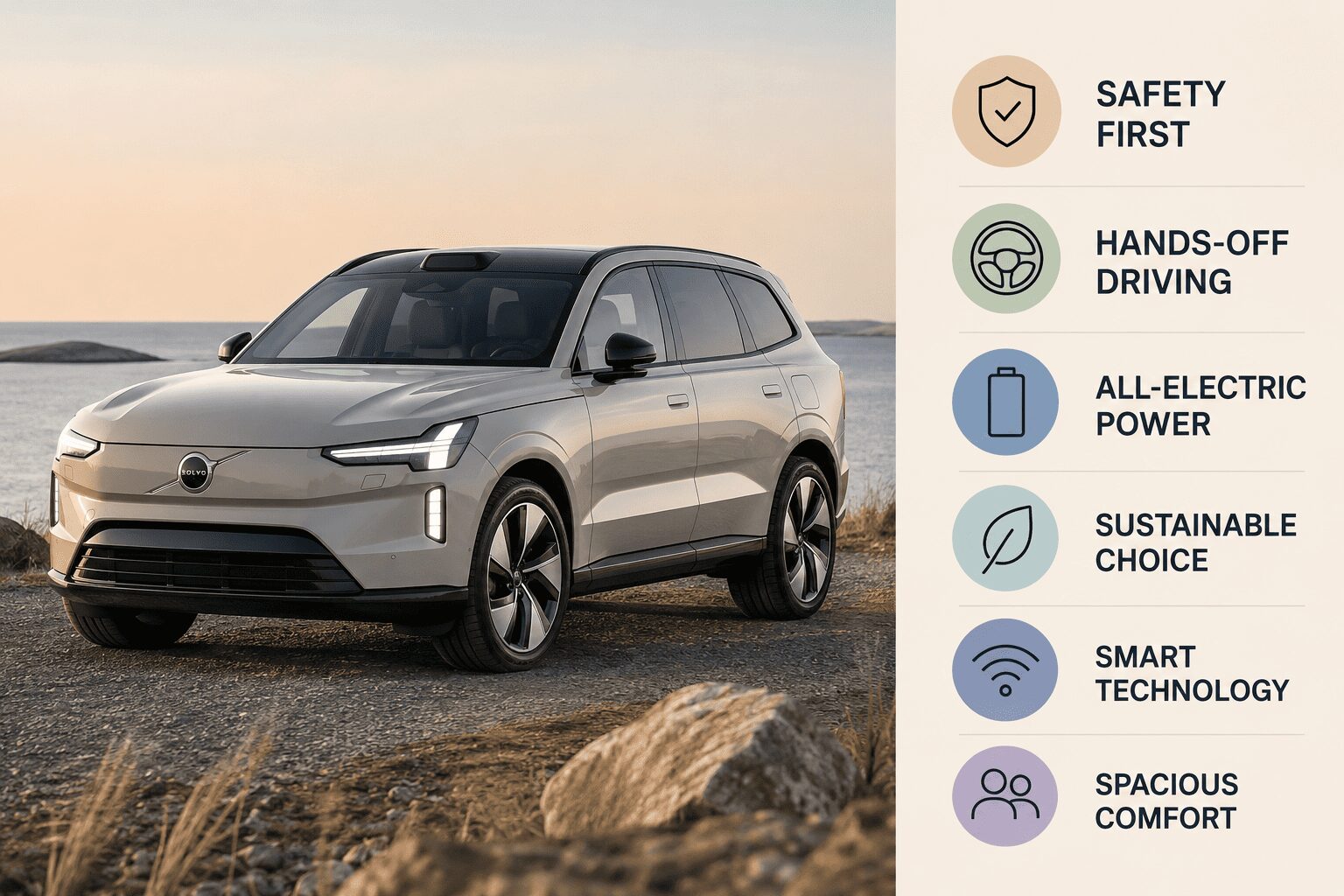
Volvo EX90: Worth the Price? A Practical Review
The Volvo EX90 is the brand’s large electric SUV, built for buyers who want space, safety technology and long-distance EV ability in one vehicle. Volvo positions it as its flagship fully electric family SUV.
For the 2026 model, Volvo has upgraded the EX90 with an 800-volt electrical system, more computing power and additional safety and driver-support features. The Indian specifications page currently lists an AWD Twin Motor version with up to 625 km of claimed electric range.
That makes the Volvo EX90 interesting, but its size and premium positioning also create a practical question: is a large electric SUV really the right choice for you?
Volvo EX90 at a glance
The Volvo EX90 combines a large three-row-style SUV body with an electric powertrain, advanced driver assistance and a technology-heavy cabin.
According to Volvo Cars India, the current listed configuration has these headline figures:
| Attribute | Volvo EX90 |
|---|---|
| Powertrain | Twin Motor AWD |
| Seats | 6 |
| Claimed electric range | Up to 625 km |
| Maximum power | 335 kW / 456 hp |
| Maximum torque | 670 Nm |
| 0–100 km/h | 5.5 seconds |
| Battery | 106 kWh nominal |
| DC charging | 10–80% in 22 minutes |
| Top speed | 180 km/h |
These are market-specific figures, so you should check the exact configuration before buying. Volvo also says equipment can vary by market, model year and specification.
The combination is impressive on paper. Still, range claims aren’t the same as real-world highway range, especially in a large and heavy SUV.
Volvo EX90 range and charging
Range is one of the biggest reasons to consider the Volvo EX90.
Volvo Cars India’s current specification lists up to 625 km of electric range. The same page lists a 106 kWh nominal battery and a 10–80% DC charging time of 22 minutes when using a suitable 350 kW charger.
The 2026 upgrade is particularly significant because Volvo moved the EX90 to an 800-volt electrical architecture. Volvo says the upgraded system can add up to 250 km of range in 10 minutes under its stated charging conditions.
In practice, your experience depends on the charger, temperature, battery condition and driving conditions. A claimed maximum should therefore be treated as a benchmark rather than a promise.
For long journeys, the charging system is arguably more important than the headline range. A car that can recover substantial range during a short charging stop can be easier to live with than one that simply posts a larger laboratory number.
Volvo EX90 interior and space
The Volvo EX90 is designed around family use rather than sporty compactness.
Volvo lists a maximum luggage capacity of 2,135 litres with the seats folded and a 46-litre front storage compartment. With the third row raised, the listed open luggage capacity is 324 litres.
That makes the Volvo EX90 especially appealing if you regularly carry people, luggage or both.
The cabin also takes a minimalist technology approach. A 14.5-inch central touchscreen handles navigation, entertainment, climate controls, apps and several vehicle functions. Volvo also lists USB-C charging ports across the cabin.
The downside is familiar with large technology-heavy vehicles: more functions depend on screens and software. If you prefer physical controls and a simpler dashboard, the EX90 may take some adjustment.
Volvo EX90 safety technology
Safety is where the Volvo EX90 has a particularly strong identity.
Volvo says the vehicle uses a high-strength steel safety cage around the occupants, with deformation zones designed to manage crash forces. The battery also has its own protective structure.
The 2026 update adds more computing power through dual NVIDIA DRIVE AGX Orin-based computers. Volvo says this enables additional safety and driver-support functions, including expanded automatic emergency steering in darkness and other connected safety capabilities.
However, advanced driver assistance should not be confused with autonomous driving. The driver remains responsible for supervising the vehicle and responding appropriately to road conditions.
For a detailed understanding of available assistance systems, Volvo’s EX90 support and guides are worth checking before making assumptions about what a particular version can do.
Volvo EX90 vs Volvo XC90
The closest alternative isn’t another brand. It’s the Volvo XC90.
The XC90 remains relevant because it gives buyers the familiar large Volvo SUV formula without requiring a fully electric commitment. The EX90, by contrast, is Volvo’s fully electric answer for this segment.
| Attribute | Volvo EX90 | Volvo XC90 |
|---|---|---|
| Power source | Fully electric | Plug-in hybrid / other market-dependent versions |
| Main appeal | Electric driving and technology | Flexibility and long-distance convenience |
| Charging | Required for electric driving | Relevant mainly to plug-in hybrid use |
| Cabin focus | Digital, electric flagship | Traditional large Volvo SUV |
| Best suited to | EV-ready families | Buyers wanting greater powertrain flexibility |
The choice is therefore less about which SUV is universally better. It’s about whether your lifestyle supports a large EV.
If you can charge at home and regularly drive within a predictable charging network, the EX90 makes more sense. If you frequently travel through areas where charging is inconvenient, the XC90’s powertrain flexibility can be the safer choice.
Volvo EX90 price and ownership reality
Price is one area where you should avoid relying on a single global figure.
Volvo’s U.S. website currently lists the 2026 EX90 from $78,090 MSRP, while the Indian specifications page focuses on vehicle specifications rather than providing a comparable India starting price. Those figures should not be treated as interchangeable because taxes, equipment and market positioning differ.
For an Indian buyer, the more useful question is the final on-road price in your city, along with charging access and service support.
Before committing, check:
- The exact EX90 variant available locally
- Current ex-showroom and on-road pricing
- Home charger installation requirements
- Fast-charging availability on your regular routes
- Insurance and maintenance costs
- Warranty terms
- Delivery timing and equipment
Volvo states that its fully electric car batteries are covered for eight years or 160,000 km, whichever comes first, subject to the stated conditions.
Who should buy the Volvo EX90?
The Volvo EX90 makes the most sense for a specific kind of buyer.
You should consider it if you want:
- A large premium electric SUV
- Strong emphasis on safety technology
- A spacious family-oriented cabin
- Fast DC charging capability
- Advanced connected features
- A quieter electric driving experience
- A vehicle designed around regular home charging
It may not be the right choice if you mainly want a smaller city vehicle, have no convenient charging access or rarely need a large SUV.
There’s also a simple financial objection: paying for a large premium EV doesn’t make sense if your daily driving needs could be handled comfortably by a smaller electric car.
What’s still unknown or worth checking?
Specifications can look definitive online while the actual buying decision remains more complicated.
For the Volvo EX90, local availability, exact equipment, final Indian pricing and delivery details should be verified against the specific vehicle being offered to you. Volvo itself warns that features can vary between markets, equipment levels and model years.
Real-world range is another variable. Temperature, traffic, speed, terrain, tyre choice and cabin climate use can all affect how far an EV travels between charges.
So don’t buy based only on the maximum range number.
Ask for a test drive, check the charging route you actually use and calculate the ownership cost for your own driving pattern. That’s more useful than comparing brochure figures alone.
Is the Volvo EX90 worth it?
The Volvo EX90 looks strongest as a premium family EV rather than simply another luxury SUV.
Its biggest advantages are the combination of space, electric range, fast charging, safety technology and a modern software architecture. The 2026 upgrades make the charging and computing package more compelling than the earlier version.
The main trade-off is size and cost. If you don’t need three-row practicality or premium electric-SUV space, a smaller EV can be easier to park, cheaper to run and better suited to everyday city use.
For buyers who genuinely need a large electric family vehicle, however, the EX90 has a convincing reason to exist.
Frequently Asked Questions
What is the Volvo EX90?
The Volvo EX90 is Volvo’s large fully electric SUV. It combines a spacious family-oriented cabin with advanced safety, driver-support and connected technology.
What is the Volvo EX90 range?
Volvo Cars India’s current specification lists up to 625 km of electric range for the listed Twin Motor AWD configuration. Actual range varies with driving conditions and other factors.
How fast can the Volvo EX90 charge?
Volvo lists a 10–80% DC charging time of 22 minutes under specified conditions using a suitable 350 kW charger. Charging performance can vary in real use.
Is the Volvo EX90 better than the XC90?
Neither is automatically better. The EX90 suits buyers ready for a fully electric large SUV, while the XC90 can suit buyers who want more powertrain flexibility.
Is the Volvo EX90 available in India?
Volvo Cars India currently has an EX90 model page and specifications page, but the exact variant, equipment, pricing and availability should be confirmed for your location before purchase.
Final Thoughts
The Volvo EX90 is most convincing when you judge it as a complete family vehicle rather than as a collection of specifications. Its large cabin, electric powertrain, safety systems and faster-charging 800-volt architecture give it a clear premium-EV identity.
The smart approach is to verify the local version instead of assuming every international specification applies to your market. For Indian buyers especially, charging access and final on-road pricing should be part of the decision from day one.
Key Takeaways
- The EX90’s strongest case is combining family space with serious long-distance EV capability.
- Its 2026 electrical and computing upgrades make the package more future-focused, but also more technology-dependent.
- The XC90 remains the more flexible choice if charging access is uncertain.
- Maximum range figures are useful benchmarks, not guarantees of real-world driving distance.
- The EX90 is worth considering when you genuinely need a large premium electric SUV rather than simply wanting the newest Volvo.
Also Read :
2027 Kawasaki Ninja 500 India Price: Best Honest Buy?